Ease of Use: Frequent Use Does Not Equal Easy Operation
In China, only a small number of hospitals employ dedicated C‑arm technicians. In most facilities, C‑arm operators rotate frequently: they may be nurses, junior doctors, visiting scholars, or scrub staff. In such settings, operators often receive no formal training. If the device has complicated workflows and a steep learning curve, the following problems are amplified:
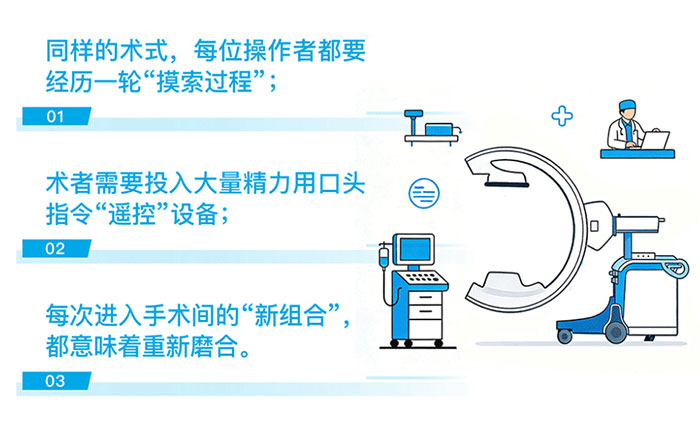
- Every operator must go through a trial‑and‑error process for the same surgical procedure;
- Surgeons spend substantial effort verbally directing the equipment remotely;
- Every new team entering the operating room requires fresh rounds of adaptation.
This highlights the importance of streamlined workflows and intuitive controls to reduce learning costs and communication burdens. In high‑volume, fast‑paced operating rooms, usability is no longer an optional bonus feature; it forms a critical foundation for efficiency and safety. Usability refers not merely to simple operation inside the OR, but the full lifecycle — from wheeling the unit out of storage to returning it. Most importantly, it covers the entire process of acquiring high‑quality images.
Predictability: The Issue Shifts From “Clear or Not” to “Stable and Accurate”
Another prominent limitation of 2D C‑arms in daily use: before exposure, surgeons struggle to reliably predict the timing, angle and quality of the upcoming image. Common pain points include unpredictable positioning time. Even for identical procedures, setup may take only seconds in one case. Constrained by the C‑arm’s mechanical structure, other cases require multiple repositioning runs and large angular adjustments. This creates major uncertainty in total operative time and the duration of each critical step.
Image quality fluctuates significantly. If the target is off‑center on the detector or the angle deviates slightly, image quality drops sharply, often necessitating retakes. Minor changes in exposure parameters alter the definition of plate and screw edges, leaving surgeons without consistent expectations. Frequent retakes increase both procedure time and radiation dose. Poor angles, positioning or parameter selections trigger repeated exposures, compounding time costs and radiation burden.
When evaluating devices, the key pain point for 2D C‑arms has evolved from “clarity of a single image” toward predictable and repeatable intraoperative imaging workflows.
Operator Consistency: The Same Device, Widely Variable Results Between Users
A common observation across many departments: experienced technicians produce stable image composition, angle selection and operating rhythm on the same C‑arm. By contrast, newly hired or rotating staff deliver noticeably poorer image quality and slower positioning.
A core cause is complex, non‑intuitive operation and the lack of standardized, reusable workflows. Typical positioning and angles for common procedures rely heavily on personal memory. Exposure parameters, dose strategies, and coordination between fluoroscopy and spot radiography often reflect individual habits rather than systematic workflow design. Even for the same procedure and anatomical site, different operators frequently need repeated trial runs, making consistent results hard to achieve.
In daily scenarios with multiple procedures and rotating operators, the value of the 2D C‑arm is being redefined: moving from “performance dependent on skilled operators” toward “an intelligent control platform.” The goal is to decouple image quality from operator experience and deliver truly consistent outcomes.
Device Rhythm vs. Surgical Rhythm: Which Serves Which?
Ideally, intraoperative imaging is a natural part of surgery. It delivers fast, accurate feedback at key decision points without disrupting the surgeon’s thought process or pace. In reality, 2D C‑arms often break workflow continuity. Surgeons must pause the operation to direct equipment movement and angle adjustment.
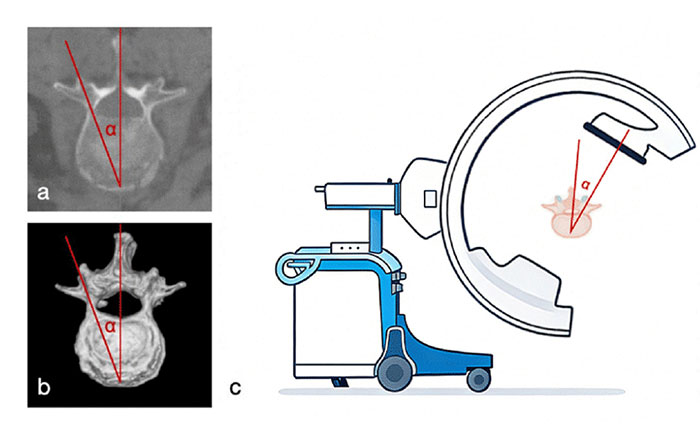
For example, when capturing an oblique view of pedicles in prone patients, the ideal image visualizes both proximal and distal pedicles. If the C‑arm cannot reach an extension angle of 45° to 55°, the distal pedicle oblique view becomes unobtainable, forcing alternative approaches.
Poor integration between the control panel, C‑arm gantry and display terminal forces users to switch between multiple interfaces and raises cognitive load. Each cycle of “position in — adjust — verify — retake” fragments the surgical workflow.
Predictably Clear Imaging: From “Trying to See” to “Predictably Clear Images”
Overall, with widespread adoption of flat‑panel detectors, the core challenge of 2D C‑arms has shifted from the traditional goal of “just being able to see the anatomy” to four priorities:
- Usability, to accommodate high turnover among operators;
- Predictability, enabling surgeons to reasonably estimate positioning time and image quality before exposure;
- Operator‑independent consistency, maintaining comparable image quality across different users;
- Alignment with surgical rhythm, supporting rather than dictating the operation.
As an illustration: surgeons use quick toe taps on the foot pedal to minimize radiation during fluoroscopy. Some systems produce acceptable images within a very short 0.2–1 second window. Others require up to 5 seconds to render an image. Such long delays disrupt surgical flow and cause delays.
Resolving these challenges ushers 2D C‑arms into a new era — moving beyond “seeing clearly” toward “seeing accurately, stably and reliably.”